Booth instrument · Desktop · Local-first
From the first drop to festival video mapping. Without changing tools.
LumaDeck Pro is your live video instrument. Open it, drag your clips in and start playing — and when the show grows, the same project grows with it: timeline, scenes, video mapping and multi-output. Same file, same engine, no wall in between.
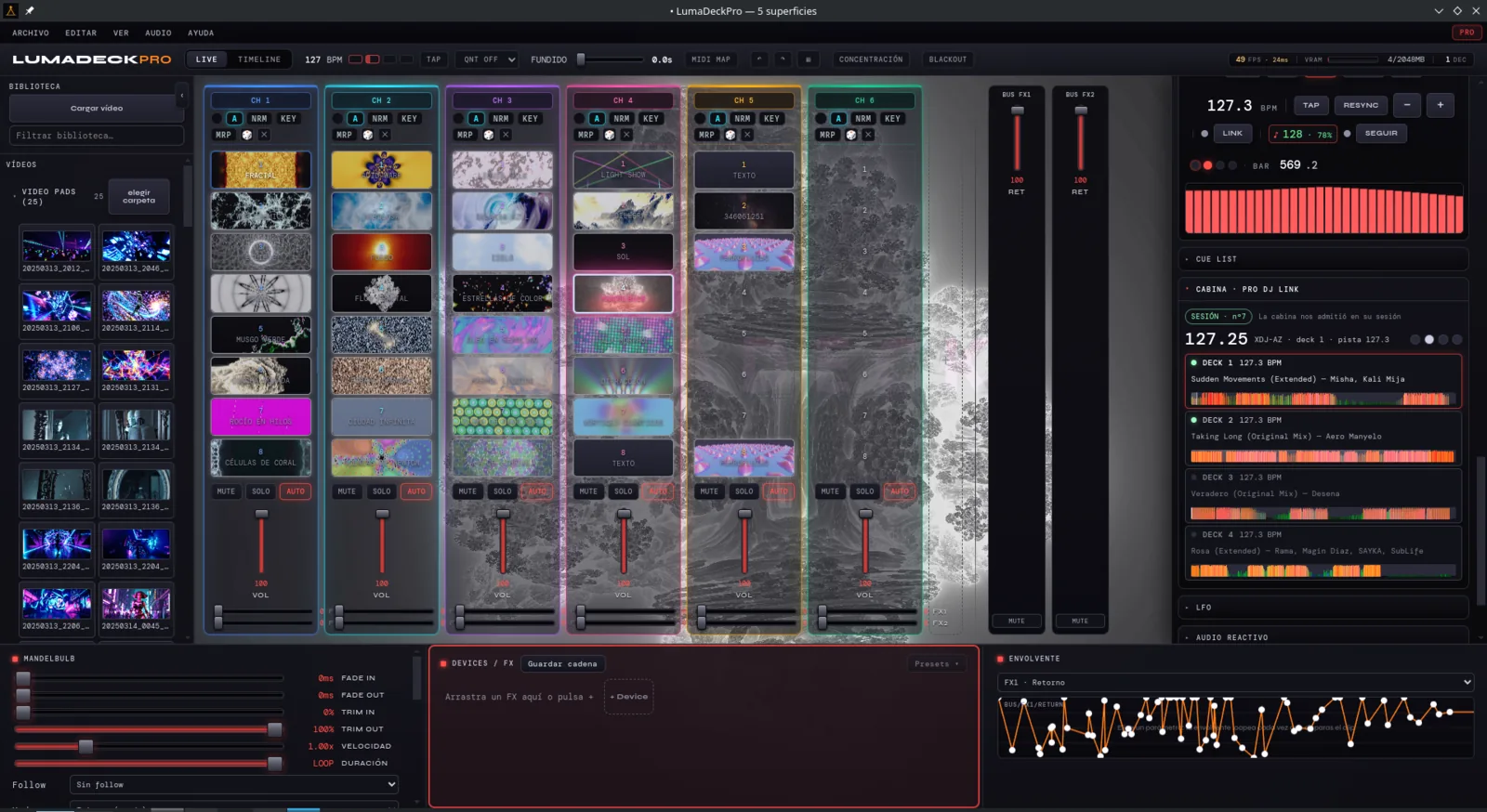
Immediate floor. Deep ceiling. The same booth.
Immediacy is the starting point, not the limit. You begin playing visuals like an instrument and end up directing a festival show — without switching software or rebuilding your set.
Immediate
Drag in your videos, fire them on the beat and the engine reacts to the music. The AUTO carries the section if you want hands-free.
Deep
Timeline, A/B scenes, FX chain, macros and a show-runner cue list. The depth of a live console — when you need it, not before.
No wall
The set you opened the club with is the same file you map onto the festival facade. Your work doesn't get left behind when you level up.
Editable video mapping, reproducible booth, one master.
We don't sell extra effects. We sell live control that repeats exactly every set, and one composed master feeding both your preview and the audience output.
Immediate video mapping
Shape the master with four-corner warp and Bézier masks, then assign each surface to its output. Every vertex stays editable while you work.
Manual · editable liveReproducible booth
You play, it's recorded, you refine it. Last night's improvisation becomes a show that fires the same way for the rest of the tour.
One master, every view
The preview and the audience output are fed by the same composed master. Performance stays visible in the health meters instead of being hidden behind a fixed claim.
One clock for the whole visual show.
Audio analysis, TAP, MIDI clock, timecode and Ableton Link converge on one tempo authority. Choose the source for the show and keep every cue, transition and visual decision on the same musical grid.
Audio becomes control
Five perceptual bands, adaptive beat detection and a confidence-aware BPM estimate turn the live signal into visual parameters.
Phase when the source provides it
Clock, timecode and Link can carry the show beyond a BPM value. When phase is available, LumaDeck locks visual beats and bar decisions to the shared musical grid instead of letting independent clocks drift.
You choose the master
Audio, TAP, MIDI, timecode or Link: the operator chooses the authority and can always take control back. The human VJ remains in command.
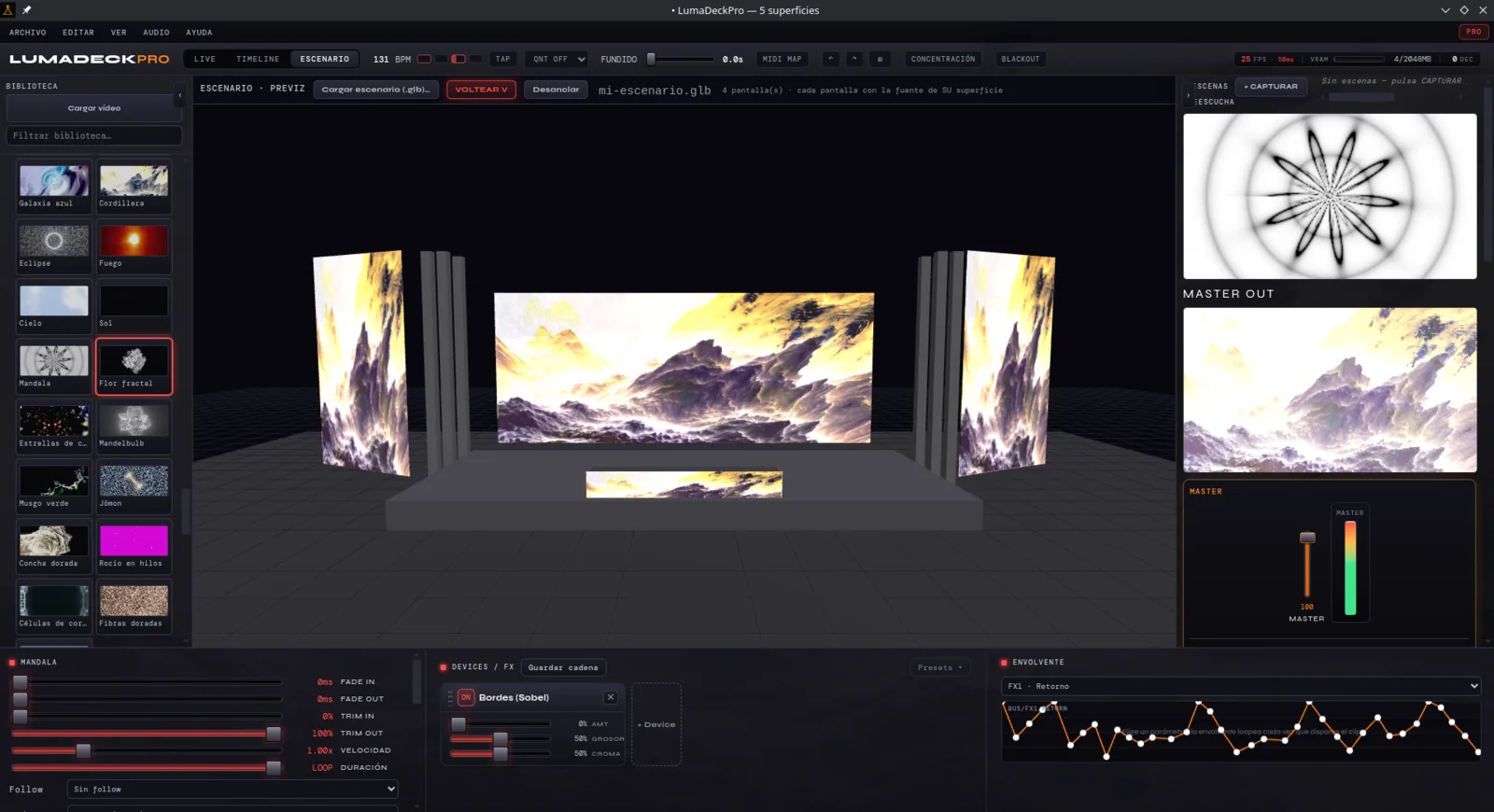
The stage, in 3D, playing your real output.
Model the venue in your 3D tool of choice, drop the file in, and every screen on that stage shows its own feed — the actual signal, not a placeholder. You prepare the show at home and arrive knowing how it lands.
Prepared before doors. Protected while you perform.
Pre-flight checks, show mode, recovery, venue profiles and visible system health keep the operator informed and the show under control.
Automatic recovery
The watchdog can relaunch the application and restore the latest show state after an unexpected stop.
Pre-flight check
Before doors open it walks the list for you: media present, VRAM, projectors, free disk, screen refresh. You find out at soundcheck, not on the drop.
Show mode
A latch for the set: an elbow at 2 a.m. no longer wipes a pad. Play everything, break nothing.
The venue, saved
Save the room's audio-to-visual latency, intended resolution and refresh, while each show keeps its own mapping and output assignments.
In time with the room, not the desk
Sound takes time to cross a room. You dial that in and the visual lands with the hit the crowd hears — not the one the desk captured. Nobody at the back sees it late.
Visible system health
Keep frame rate, the GPU memory the engine manages and decoder use visible while you work.
Being pro isn't having more effects: it's joining the show's network.
On a big stage nobody works alone. LumaDeck Pro speaks the language of the booth, the lights and the timecode desk, so your video is part of the show and not a patch on the side.
One clock, one truth
Booth, timecode desk or your own tap: you pick who's master and everything else follows. No two clocks arguing mid-set.
Lights from the video
Art-Net out, DMX over the network: tint the fixtures with the colour of your master in real time. Video and light, as one.
You buy it. You don't rent it.
This corner of the industry has been drifting to subscriptions and yearly renewals for a while now. We're not going there. One payment, and the instrument is yours — no monthly fee that can cut your show, and no renewal to keep what you already bought.
- The full engine, forever — bought once.
- 1 year of LumaDeck Web Pro included* — for the LumaDeck account that already uses the same email when you buy.
- Local-first: works offline, your shows are yours.
- All 1.x updates included. No subscription and no forced update to keep using the version you bought.
Coming to Linux and Windows. Join the waitlist today; no payment is taken until LumaDeck Pro launches.